
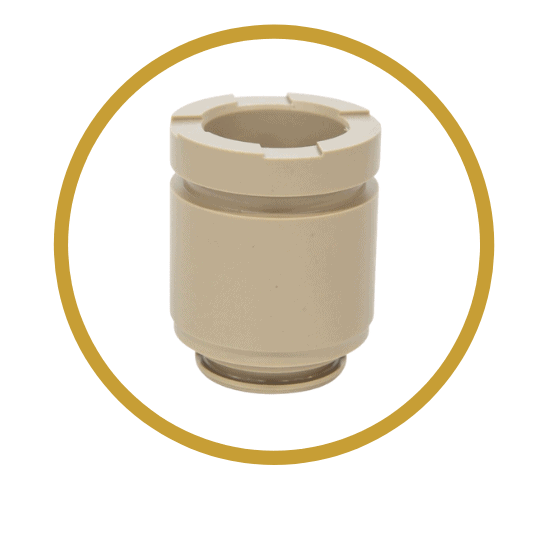
Glass-Filled PEEK Components for Demanding Applications
Your engineering team specified glass-filled PEEK for a reason. The application demands a material that won’t compromise under extreme temperature, aggressive chemicals, or continuous mechanical stress. Now you need a manufacturing partner who understands what that specification actually means—and can deliver parts that perform.
The Problem with Standard Plastics
Standard engineering plastics fail when conditions get serious. They creep under load. They degrade in chemical environments. They lose dimensional stability as temperatures climb. You’ve seen it before: parts that test fine in the lab but fail in the field. Components that worked for six months, then didn’t.
Metal replacements seem like the safe choice—until weight becomes critical, or electrical conductivity creates problems, or corrosion starts eating away at your margins. Ceramic solves some problems but introduces brittleness and machining limitations you can’t design around.
Glass fiber reinforced polyetheretherketone changes the equation. PEEK’s inherent chemical resistance, temperature performance, and mechanical properties get amplified by glass fiber reinforcement. The composite delivers stiffness approaching metals at a fraction of the weight, maintains performance from cryogenic to 480°F continuous use, and resists the chemicals that destroy lesser materials.
We Machine Glass-Filled PEEK Right
Advanced Industrial specializes in precision machining of high-performance polymers. Where injection molded PEEK suits high-volume commodity production, machined components deliver the dimensional precision and complex geometries that critical applications demand. glass-filled PEEK represents some of the most demanding work we do—and we’ve developed the processes, tooling, and expertise to do it consistently.
Glass fiber reinforced PEEK machines differently than unfilled grades. The fibers are abrasive. They punish tooling. They create surface finish challenges if you don’t understand how the material behaves. We do.
Our capabilities include:
- Tight-tolerance machining from rod, plate, and custom stock shapes
- Complex geometries for aerospace, semicon, oil and gas, and medical device applications
- ESD-safe grades for electronics manufacturing environments
- FDA-compliant formulations for food processing equipment
- Implant-grade PEEK machining for medical components requiring biocompatibility
We work from customer specifications, material datasheets, and application requirements to deliver components that meet print—every time.
Don’t Pick The Wrong Glass-Filled PEEK Partner
The wrong manufacturing partner costs more than a rejected lot. Dimensional errors in precision assemblies cascade into system failures. Surface finish problems in sealing applications become leak paths. Machining heat damage degrades the polymer matrix and creates invisible weaknesses that show up as field failures.
Glass-filled PEEK stock isn’t cheap. Neither is your engineering team’s time. Neither is a production delay while you source replacements.
If glass-filled PEEK is the right material, we’ll prove we’re the right manufacturer. If PTFE, carbon fiber PEEK, ceramic-filled grades, or unfilled polyether ether ketone makes more sense for your application, we’ll tell you that too.
Start With a Conversation
Characteristics of Glass-Filled PEEK
Glass-filled PEEK (specifically the 30% glass fiber reinforced extruded grade, or GF30) takes the base properties of polyetheretherketone and amplifies them where it counts. The glass fibers cut the thermal expansion rate substantially and roughly double the flexural modulus compared to unfilled PEEK. That makes this grade the right call for structural applications where stiffness, dimensional stability, and elevated-temperature performance all matter – particularly above 300 degrees F, where most engineering thermoplastics start to lose their footing.
Here’s what the material actually delivers:
Physical
- Specific gravity: 1.51 g/cc – roughly one-fifth the density of steel
- Water absorption (24-hour immersion): 0.10%
- Water absorption at saturation: 0.30%
Mechanical
- Tensile strength: 14,000 psi (96.5 MPa)
- Tensile modulus: 1,000 ksi (6.89 GPa)
- Flexural yield strength: 23,000 psi (159 MPa)
- Flexural modulus: 1,000 ksi (6.89 GPa)
- Compressive strength: 22,000 psi (152 MPa) at 10% deformation
- Compressive modulus: 550 ksi (3.79 GPa)
- Shear strength: 14,000 psi (96.5 MPa)
- Elongation at break: 2.0%
- Izod impact, notched: 0.800 ft-lb/in
- Hardness: Rockwell M103 / R126, Shore D89
Thermal
- Maximum continuous service temperature in air: 480 degrees F (249 C)
- Melting point: 644 degrees F (340 C)
- Heat deflection temperature at 264 psi: 450 degrees F (232 C)
- Coefficient of thermal expansion: 12.0 microinch/in-F across -40 F to 300 F
- Thermal conductivity: 2.98 BTU-in/hr-ft2-F (0.429 W/m-K)
- Flammability rating: UL94 V-0 at 1/8 inch (estimated)
Electrical
- Surface resistivity: 1.00 x 10^13 ohms or greater per square – this is an insulating grade, not static-dissipative
- Dielectric strength: 500 kV/in (19.7 kV/mm), short term
Chemical Resistance
Glass-filled PEEK handles the chemical families that destroy most thermoplastics. It performs acceptably against:
- Weak acids, weak and strong alkalies
- Alcohols, ketones, and esters
- Aliphatic and aromatic hydrocarbons
- Chlorinated solvents
- Inorganic salt solutions
- Hot water and steam
It has limited resistance to strong acids (pH 1-3) and continuous UV exposure. For applications involving concentrated mineral acids or long-term outdoor service without protection, that’s a constraint worth designing around.
Compliance (standard extruded GF30 grade)
This specific grade does not carry FDA, NSF, USDA, USP Class VI, 3A-Dairy, or Canada AG certifications. Applications requiring those approvals call for a different PEEK formulation – which we also machine.
Check out our Glass-filled PEEK datasheet.
Engineering and High-Performance Plastics Used for Machined Components
Our eBook breaks down six of the most commonly used high-performance plastics to aid in your material selection process.

How to Eliminate the Wrong Material From Your Application
In this guide, we discuss the process of eliminating the wrong material from your application and outline important factors to take into consideration when narrowing down your list of potential manufacturing materials.