PPS (Polyphenylene Sulfide) Plastic Machining & Fabrication
Polyphenylene sulfide, or PPS plastic, is a semi-crystalline thermoplastic that delivers exceptional chemical resistance and mechanical strength at elevated temperatures. Its unique molecular structure gives it chemical resistance second only to PTFE—broader than even PEEK—while maintaining tensile strength and structural integrity above 200°C. For applications requiring continuous exposure to aggressive chemicals or high temperatures, PPS offers a compelling combination of performance and value.
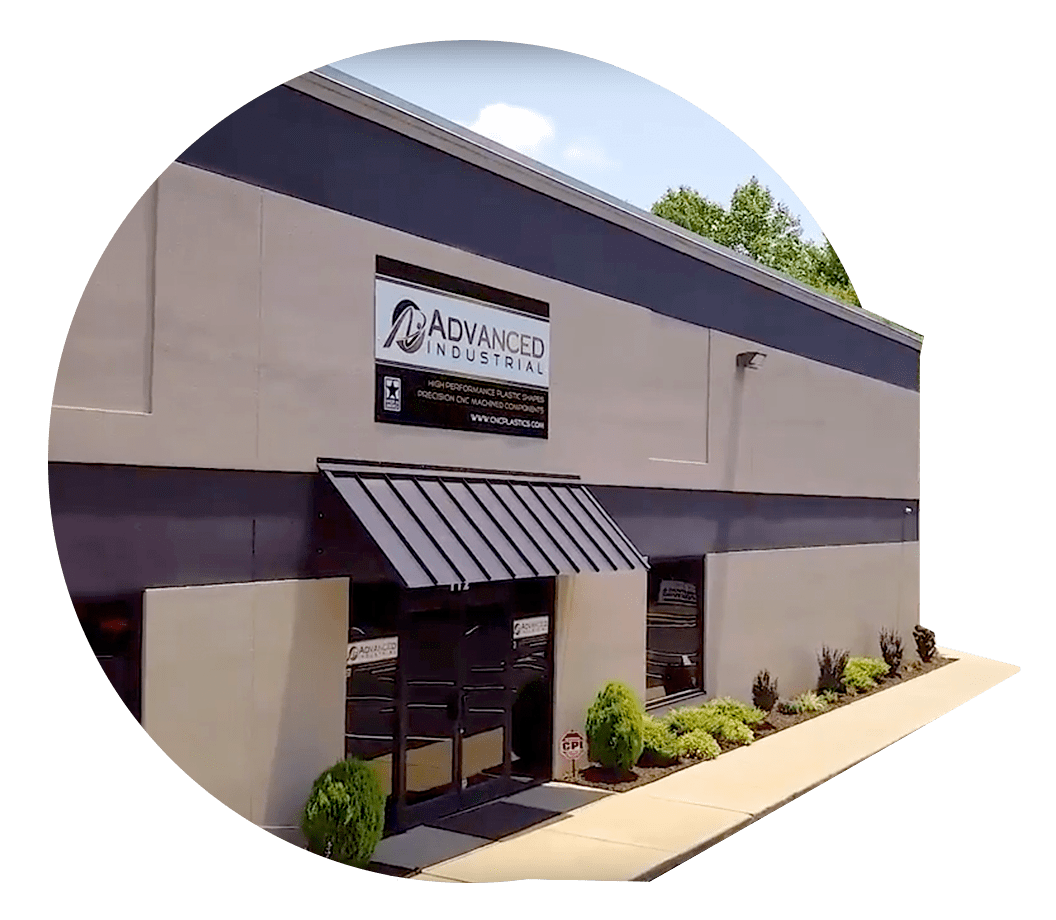
At Advanced Industrial, we specialize in precision CNC machining of PPS components for demanding industries. Our 20,000 square-foot facility houses state-of-the-art CNC equipment operated by Journey-level machinists recruited from across the country. We maintain extensive inventory of PPS stock shapes including sheets, rods, tubes, and bars, enabling us to deliver precision-machined parts quickly without the typical distributor markup. Whether you need a prototype or a production run, our integrated distributor/fabricator model means better pricing and faster turnaround.
Request a Quote for PPS Plastic Machining
What Makes PPS Different
The performance profile of PPS sets it apart from other engineering thermoplastics. It maintains chemical resistance and tensile strength even when exposed to temperatures exceeding 200°C, making it valuable for under-the-hood automotive applications and chemical processing equipment. The material absorbs very little water and resists hot water and steam without degrading. Its dimensional stability remains excellent across a wide temperature range.
PPS also brings inherent flame resistance and outstanding electrical properties. The dielectric and insulating characteristics stay stable across varying conditions, which matters for electronics and semiconductor applications. But what really distinguishes PPS from materials like PEEK is its machinability.
The lower internal stress in PPS results in less bending during machining and reduced warpage in finished parts. This is especially important for components made from PPS sheets that require high flatness tolerances. You’ll see less burr formation and shorter chips compared to PEEK, which translates to cleaner machining and better yields. Parts with delicate structures or micro-holes often turn out better in PPS than in higher-ductility materials. The lower stress characteristics also mean you can run faster speeds and feeds, and intermittent post-annealing steps between operations become largely unnecessary. The result is faster production and lower overall costs.
PPS Material Properties
Thermal Performance
PPS handles continuous use temperatures up to 230°C. The material maintains its mechanical properties and dimensional stability even at elevated temperatures, which is why you’ll find it in automotive engine compartments and electronics where heat is constant. Short-term thermal performance is excellent as well.
The glass transition temperature sits around 97°C. Below this point, the coefficient of linear thermal expansion runs about 6×10⁻⁵/K. Above the glass transition temperature, thermal expansion increases to roughly 11×10⁻⁵/K in the 100-150°C range. Understanding this behavior is important for applications that cycle through this temperature range, as dimensional changes will be more pronounced above the glass transition point.
Chemical and Environmental Resistance
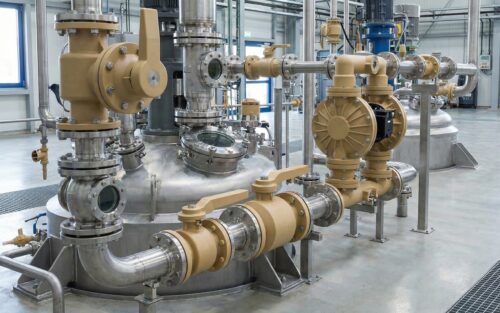
The chemical resistance of PPS is exceptional. Only PTFE outperforms it in this regard—PPS actually has broader chemical resistance than PEEK. It holds up to automotive fluids, acids, bases, and a wide array of industrial solvents. The material resists corrosion in harsh environments and doesn’t degrade when exposed to hot water or steam.
This makes PPS a go-to choice for chemical processing equipment, where components might see continuous exposure to aggressive chemicals. Valves, pumps, nozzles, and process equipment parts benefit from PPS’s ability to maintain integrity in corrosive environments that would quickly degrade other materials.
Mechanical Characteristics
PPS offers high tensile strength and rigidity. The unfilled material delivers 103 MPa tensile strength, and glass fiber reinforcement can increase this significantly. Compressive strength is actually higher than PEEK—134 MPa at 5% compared to PEEK’s 102 MPa. The material has good toughness overall, with a notched Charpy impact strength of 2.6 kJ/m².
Where PPS differs from PEEK is in ductility. With an elongation at break of 6.5%, it’s less ductile than PEEK’s 15%. This affects how the material behaves under certain loading conditions. Lower ductility means a slightly higher risk of cracking under extreme stress, but it also contributes to PPS’s superior machinability and cleaner cutting characteristics.
Dimensional stability is excellent even above 200°C. The material doesn’t creep significantly under load at elevated temperatures, and it maintains tight tolerances through thermal cycling. Water absorption is very low, so parts don’t swell or dimensionally shift in humid environments.
Electrical Properties
The dielectric properties of PPS are excellent and remain stable across a wide range of environmental conditions. It provides outstanding electrical insulation, which is valuable for connectors, contact rails, and other electrical components. The material is inherently flame-resistant, meeting flammability requirements without additives.
PPS vs. PEEK: Choosing the Right Material
Both PPS and PEEK are high-performance thermoplastics, but they excel in different areas. Understanding where each material performs best helps you make the right choice for your application.
When PPS is the Better Choice
Chemical resistance is where PPS really shines. If your application involves aggressive chemicals—particularly combinations of different chemicals or long-term exposure—PPS’s broader resistance profile often makes it the better option. It’s more resistant to a wider range of chemicals than PEEK, which can be decisive for chemical processing equipment.
Cost matters too. PPS is less expensive than PEEK, sometimes significantly so. When PPS properties meet or exceed your application requirements, choosing PPS over PEEK can substantially reduce material costs without compromising performance. For projects where chemical resistance is critical but the extreme wear resistance of PEEK isn’t needed, PPS delivers better value.
Machinability is another factor. Complex parts with delicate features, thin walls, or micro-holes are often easier to machine successfully in PPS. The lower internal stress and reduced warpage mean you’re more likely to hold tight tolerances on intricate geometries. Production rates can be higher because faster speeds and feeds are possible, and you’ll see better yields with less scrap.
PPS also delivers higher compressive strength than PEEK, which matters for applications where parts experience compressive loads. And for sheet applications requiring exceptional flatness, PPS’s low internal stress gives it an edge.
When PEEK is the Better Choice
PEEK’s higher ductility—15% elongation at break compared to PPS’s 6.5%—gives it advantages in applications involving impact or shock loading. This translates to higher tensile strength (166 MPa vs. 103 MPa for unfilled grades) and superior impact resistance (4 kJ/m² vs. 2.6 kJ/m² notched Charpy).
Wear resistance is PEEK’s strong suit. For applications involving sliding contact, friction, or abrasion, PEEK typically outperforms PPS. Bearing applications, wear strips, and components in high-wear environments often benefit from PEEK’s wear characteristics.
Temperature capability slightly favors PEEK for the most demanding continuous high-temperature applications. And the higher ductility means lower risk of brittle failure in parts that experience high stress concentrations or impact loads.
Making the Decision
Start by mapping your application requirements:
Temperature range – What’s the continuous operating temperature, and are there thermal spikes? Both materials handle high temperatures, but the specific range matters.
Chemical exposure – What chemicals will the part contact, at what concentrations, and for how long? PPS’s broader chemical resistance often wins here.
Mechanical loads – Is wear a concern? Are there impact loads? PEEK’s higher ductility and wear resistance matter for these applications.
Part geometry – Are there delicate features, micro-holes, or tight flatness requirements? PPS’s machinability advantages show up in complex geometries.
Budget – What’s the total cost of ownership? PPS’s lower material cost and better machinability can significantly reduce total part cost.
For many applications, PPS properties exceed requirements. When that’s the case, PPS is typically the smarter choice from both a performance and cost perspective.
Available PPS Grades and Forms
Advanced Industrial maintains substantial inventory of PPS stock shapes. We carry sheets in various thicknesses for precision cutting and flat components. Rods and bars are available in multiple diameters for turned parts and cylindrical components. Tubes and tubular bars can be machined into bushings, spacers, and other hollow components.
Unfilled PPS is available in natural and various colors for applications where the base polymer properties are sufficient. For enhanced strength and rigidity, glass fiber reinforced grades like PPS GF40 (40% glass fiber) provide higher mechanical performance while maintaining chemical resistance and thermal stability. Other specialized grades can be sourced as project requirements dictate.
Advanced Industrial’s PPS Machining Capabilities
Our 20,000 square-foot facility in Mooresville, NC houses nine CNC mills and five CNC lathes, all American-made equipment chosen for precision and reliability. We run 3-axis, 4-axis, and 5-axis machining operations, giving us flexibility to handle everything from simple turned parts to complex multi-surface components.
The Journey-level machinists we recruit from across the country bring extensive experience machining high-performance plastics. They understand how PPS behaves differently from metals and from other plastics. Our proprietary approach accounts for every variable that affects dimensional accuracy and surface finish in PPS—workpiece orientation and workholding strategies, feed rates optimized for PPS’s characteristics, cutting speeds that balance productivity with part quality, and careful tool selection.
We determine all relevant parameters before production starts. This front-end work reduces the risk of chipping, minimizes burr formation, and enhances dimensional stability in finished parts. For PPS specifically, our processes take advantage of the material’s low internal stress to achieve faster machining speeds while maintaining tight tolerances.
Custom PPS Components
We machine custom components ranging from simple bushings to complex structural parts with intricate geometries. Custom plastic bearings and wear components are a specialty. We produce plastic gears including custom spur gears machined to your specifications. Complex parts requiring multiple operations, tight tolerances, and excellent surface finish are handled in-house from start to finish.
The integrated nature of our operation—distributor and fabricator under one roof—means we can move from stock material to finished part without the delays and markup typically added by separate distributors. You get competitive pricing and faster turnaround.
Quality Assurance
Quality checks happen throughout production, not just at final inspection. Our in-house metrology equipment verifies dimensions during and after machining operations. We maintain commitment to quality from initial machining through finishing and delivery. Parts can be manufactured to meet industry standards including Mil-Spec, ISO, AMS, and RoHS requirements as your application demands.
PPS Applications Across Industries
Semiconductor Manufacturing
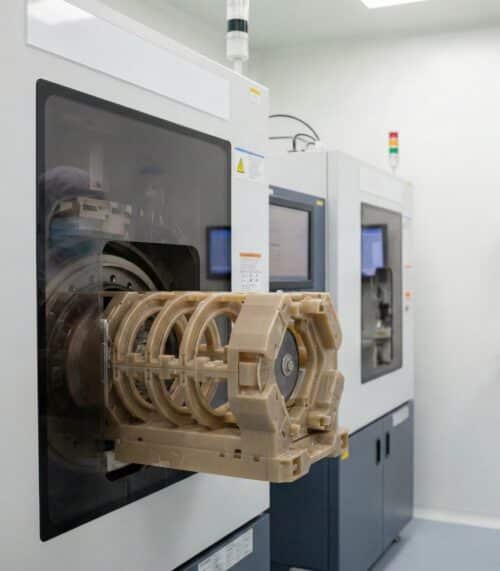
The semiconductor industry uses PPS extensively for its chemical resistance and dimensional stability. CMP retaining rings, clamp rings, and various semiconductor fabrication equipment parts are commonly machined from PPS. The material’s ability to withstand wet process chemicals while maintaining precise dimensions makes it valuable for IC test sockets and equipment components exposed to acids and bases.
Electronics
Connectors and contact rails benefit from PPS’s electrical insulating properties and temperature resistance. Heat shields protect sensitive components while maintaining structural integrity at elevated temperatures. LCD manufacturing equipment utilizes PPS for its dimensional stability and chemical resistance. Inspection fixtures for PCB, FPC, and IC package substrates are often machined from PPS because the material maintains flatness and doesn’t warp during use.
Automotive
Under-the-hood applications put materials through continuous heat, vibration, and exposure to automotive fluids. PPS handles these conditions reliably. Fuel system components resist gasoline and additives while maintaining structural integrity. Brake system parts withstand brake fluid and heat from braking operations. The combination of temperature resistance, chemical resistance, and mechanical strength makes PPS suitable for engine compartment components that would fail in lesser materials.
Medical and Healthcare
Parts for surgical instruments benefit from PPS’s sterilization resistance and chemical resistance to cleaning agents. Medical device components that require repeated autoclave cycles maintain their properties through hundreds of sterilization cycles. The material doesn’t absorb significant moisture, so dimensional stability remains consistent even in steam sterilization environments.
Mechanical Engineering
Compressor and pump parts face continuous mechanical stress and often chemical exposure. PPS gears maintain dimensional accuracy under load and resist wear. Valves and valve components benefit from chemical resistance and mechanical strength. Slide bearings, chain guides, and base plates see reliable performance in demanding mechanical applications.
Chemical Processing
This is where PPS’s exceptional chemical resistance really matters. Valves and taps that control corrosive fluids maintain sealing surfaces and dimensional accuracy. Bushings and bearing surfaces resist chemical attack while providing low-friction operation. Pumps and pump components handle aggressive chemicals without degrading. Nozzles maintain precise orifice dimensions despite continuous chemical exposure. Tubes and rollers in chemical processing equipment last longer when made from PPS.
Food and Beverage Processing
Bottling and canning equipment requires materials that resist cleaning agents, sanitizers, and the products being processed. PPS meets food-grade requirements and stands up to aggressive cleaning protocols. Components maintain dimensional accuracy through repeated cleaning and sanitization cycles without swelling or degrading.
Other Industries
Analytical instrumentation uses PPS for its dimensional stability and chemical resistance. Material handling equipment benefits from PPS’s mechanical strength and wear resistance. Marine applications take advantage of the material’s resistance to saltwater and marine chemicals. Life sciences equipment and sample preparation systems use PPS components where chemical compatibility is essential.
Why Advanced Industrial for PPS Machining
We’re both distributor and fabricator, which eliminates the typical distributor markup. You get direct pricing on material plus our machining expertise. Large inventory means we usually have the stock shapes you need without long lead times for material procurement.
Our machinists aren’t entry-level operators learning on your parts. We recruit Journey-level machinists from across the country—people with years of experience machining challenging materials. They understand how to get the best results from PPS, and they know when to adjust parameters based on what they’re seeing during machining operations.
The equipment matters too. State-of-the-art CNC machine tools give us the precision and repeatability that tight-tolerance work demands. We can handle prototype quantities or production runs, simple geometries or complex multi-axis work. From initial consultation through design review, material selection, machining, inspection, and delivery, you’re working with one team.
Technical support isn’t an afterthought. We’ll help you select between PPS and PEEK or other materials based on your actual application requirements. Design for manufacturability input can save you money and improve part performance. If there’s a better way to approach your project, we’ll tell you.
Material Selection Guide for Engineers
Choosing between PPS and other high-performance plastics comes down to matching material properties to application requirements. Here’s what to consider:
Temperature exposure – What’s the continuous operating temperature, and what are peak exposures? PPS handles continuous use to 230°C. If you’re cycling through the glass transition temperature around 97°C, plan for the increased thermal expansion above that point.
Chemical environment – List every chemical the part will contact, including cleaning agents and process fluids. Don’t forget to consider chemical combinations. PPS has exceptional broad-spectrum chemical resistance, but specific chemical compatibility should be verified for critical applications.
Mechanical loading – Will the part see steady loads, impact loads, or wear? What stresses are involved? PPS delivers excellent compressive strength and good tensile strength. For high wear applications, compare wear data between PPS and PEEK.
Dimensional requirements – What tolerances are critical? Is flatness important? PPS’s low internal stress and excellent dimensional stability help achieve and maintain tight tolerances. Complex geometries with delicate features often machine better in PPS.
Part complexity – Do you need micro-holes, thin walls, or intricate features? PPS’s superior machinability compared to PEEK often makes it the better choice for complex geometries.
Sterilization or cleaning – How often will parts be sterilized or cleaned, and by what method? PPS withstands repeated steam sterilization and resists degradation from cleaning agents.
Quantity and timeline – Prototype or production? PPS’s better machinability can reduce per-part costs in production volumes, and faster machining means quicker turnaround.
Budget constraints – What’s the target part cost? PPS typically costs less than PEEK, sometimes substantially so. When PPS meets your requirements, it usually delivers better value.
If your application involves aggressive chemicals, temperatures up to 230°C, and you need good dimensional stability, PPS should be high on your list. If cost is a concern and PPS properties meet your requirements, it’s often the smart choice over more expensive alternatives.
Technical Resources and Support
We maintain detailed material property data for the various PPS grades we stock. Specific property values for different formulations are available, and we can discuss how those properties translate to real-world performance in your application.
Design guidelines for PPS parts cover recommended wall thicknesses, achievable tolerances, surface finish expectations, and other design considerations that affect manufacturability and performance. Our team can review your designs and suggest modifications that improve machinability or part performance.
Free consultation for material selection is available. Whether you’re deciding between PPS and PEEK, or you’re not sure what material makes sense for your application, we’ll talk through the requirements and help you make an informed choice. Sample parts and prototyping services let you test designs before committing to production tooling or large quantities.
Getting Started
Submit your drawings and specifications for a quote. Include material preferences if you have them, but if you’re not sure what material is best, let us know the application requirements and we’ll provide recommendations. We turn quotes around quickly, and our pricing reflects the direct distributor/fabricator model—no middleman markup.
For material selection help or technical questions about PPS machining, give us a call at 800-265-7351. Our team can discuss your specific application and help determine if PPS is the right material for your needs.
Whether you need a prototype to prove out a design or you’re ready for a production run, Advanced Industrial brings together material expertise, machining capability, and practical experience to deliver the PPS components you need. We’ve been doing this for decades, and we’ve seen what works and what doesn’t in PPS applications across numerous industries.
Contact us to discuss your PPS project.